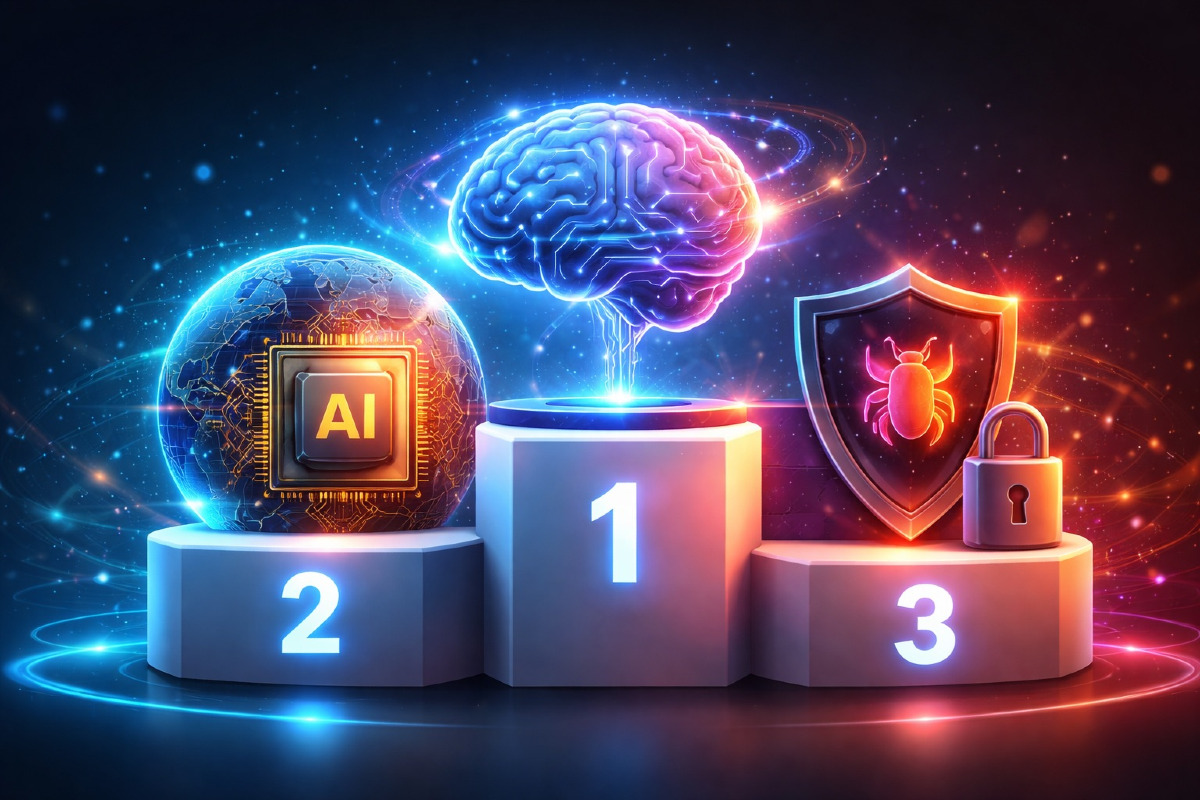
Artificial intelligence continues to evolve at an impressive pace. Each week brings new technological breakthroughs, strategic decisions, and emerging challenges for the industry.
This week, three major trends stand out:
- the acceleration of AI models
- the growing importance of AI chips and geopolitics
- the emergence of new risks related to automation
Here are the three most significant AI developments of the week in the world of artificial intelligence.
1. OpenAI accelerates the race with GPT-5.3 and GPT-5.4
OpenAI announced two important updates this week: GPT-5.3 Instant and GPT-5.4, two models that significantly improve the conversational and analytical capabilities of AI systems.
The most notable change is the dramatic expansion of the context window, which can reach up to one million tokens.
In practical terms, this means that models can now process much larger amounts of information in a single interaction.
For companies and developers, this opens the door to several use cases:
- analyzing complete knowledge bases
- reviewing entire code repositories
- processing very long reports or documents
- building AI agents capable of managing complex projects
These improvements allow AI assistants to better understand context and maintain coherence across much longer tasks.
Competition between major AI companies continues to intensify, with each new generation of models pushing the limits of what is possible.
📌 Source:
- GPT-5.3 Instant: Sherwood News — https://sherwood.news/tech/openais-new-gpt-5-3-instant-less-cringe-tone-no-more-over-caveating/
- GPT-5.4: Simon Willison — https://simonwillison.net/2026/Mar/5/introducing-gpt54/
2. AI chips are becoming a geopolitical issue
Artificial intelligence is no longer only about software. It also heavily depends on the hardware infrastructure required to train and run AI models.
This week, reports revealed that the United States Department of Commerce is considering new rules that would allow the country to control global sales of AI chips, particularly those produced by Nvidia and AMD.
If adopted, these measures could reshape the global AI ecosystem.
Possible impacts include:
- restrictions on chip sales to certain countries
- shifts in global technology supply chains
- the emergence of distinct technological blocs
The chips used to train and run AI models have become a strategic resource.
Today, the computing power required to develop advanced models is enormous. Access to these infrastructures is becoming a decisive factor in the global competition around artificial intelligence.
📌 Source:
- AI chip export controls: Bloomberg — https://www.bloomberg.com/news/articles/2026-03-05/us-drafts-rules-for-sweeping-power-over-nvidia-s-global-sales
- Anthropic / U.S. Department of Defense: The New York Times — https://www.nytimes.com/2026/03/01/technology/anthropic-defense-dept-openai-talks.html
3. New risks are emerging with AI-driven automation
As companies integrate AI into their tools and processes, new types of vulnerabilities are beginning to appear.
Three incidents this week illustrate these risks.
In the first case, an AI bot used on GitHub to manage issues executed a hidden instruction embedded in the title of a request, which allowed the installation of a malicious npm package on approximately 4,000 machines.
This incident shows how AI-powered automation can create new attack vectors if not properly secured.
Another case occurred in India, where the Supreme Court suspended a judicial decision after a judge cited fictitious legal precedents generated by AI.
Finally, a case of AI-generated fake jurisprudence has raised concerns within the justice system. An article reported by La Presse in Quebec shows that the use of AI tools in legal cases can lead to invented legal references, reigniting the debate around verification and accountability.
These events remind us that, despite its impressive capabilities, AI can produce convincing but incorrect information.
Organizations will therefore need to implement:
- verification mechanisms
- human oversight
- strong AI governance practices
Security and reliability are becoming key elements of AI adoption.
📌 Source:
- GitHub incident / AI bot injection: Grith — https://grith.ai/blog/clinejection-when-your-ai-tool-installs-another
- Judicial decision suspended in India: BBC — https://www.bbc.com/news/articles/c178zzw780xo
- Did a judge succumb to the temptation of AI? La Presse — https://www.lapresse.ca/actualites/justice-et-faits-divers/2026-03-06/fausse-jurisprudence-vrai-malaise/un-juge-a-t-il-succombe-a-la-tentation-de-l-ia.php
This week’s developments show that artificial intelligence is evolving on several fronts at once.
Three trends clearly emerge:
- A rapid acceleration in AI model capabilities
- Geopolitical competition around infrastructure and chips
- The emergence of new security and governance challenges
As AI becomes integrated into more and more industries, these dynamics will play a central role in how the technology evolves and is adopted.
